
Sturm und Drang
- Date 2014
- Unveiled 2015
- Material Bronse
- Dimensions 246 x 244 x 124 cm
© Jake & Dinos Chapman / BONO. Photo: © Kristina A. Kvåle / Ekebergparken
«The idea of making hopeful, friendly art is total nonsense to me, because generally the world is a horrible place.»

Jake & Dinos Chapman
(b. United Kingdom,)
Iakovos (b. 1966) og Konstantinos (b. 1962) Chapman, known as Jake and Dinos Chapman, or the Chapman brothers, have collaborated artistically since 1991. They work with many different media, with, often, a singular purpose: to provoke and shock the audience. Dinos studied art at Ravensbourne College of Art, and Jake at North East London Polytechnic. Both received their MA degrees from Royal College of Art. They were part of the Young British Artists (YBA) group in the 1980s, partaking in an early exhibition of the group; “Brilliant!”, in 1995 at the Walker Art Center in Minneapolis. The predominant themes in their work are ethics, religion, and politics. They find inspiration through idols from art history such as Francisco de Goya (1746–1828) and Hieronymus Bosch (ca. 1450– 1516) who both carried out extremely detailed artworks, often with morbid representations. Their work are part of, among many, the collections of The Museum of Modern Art, New York; the Tate Gallery, London; and the Hirshhorn Museum and Sculpture Garden, Washington, D.C.
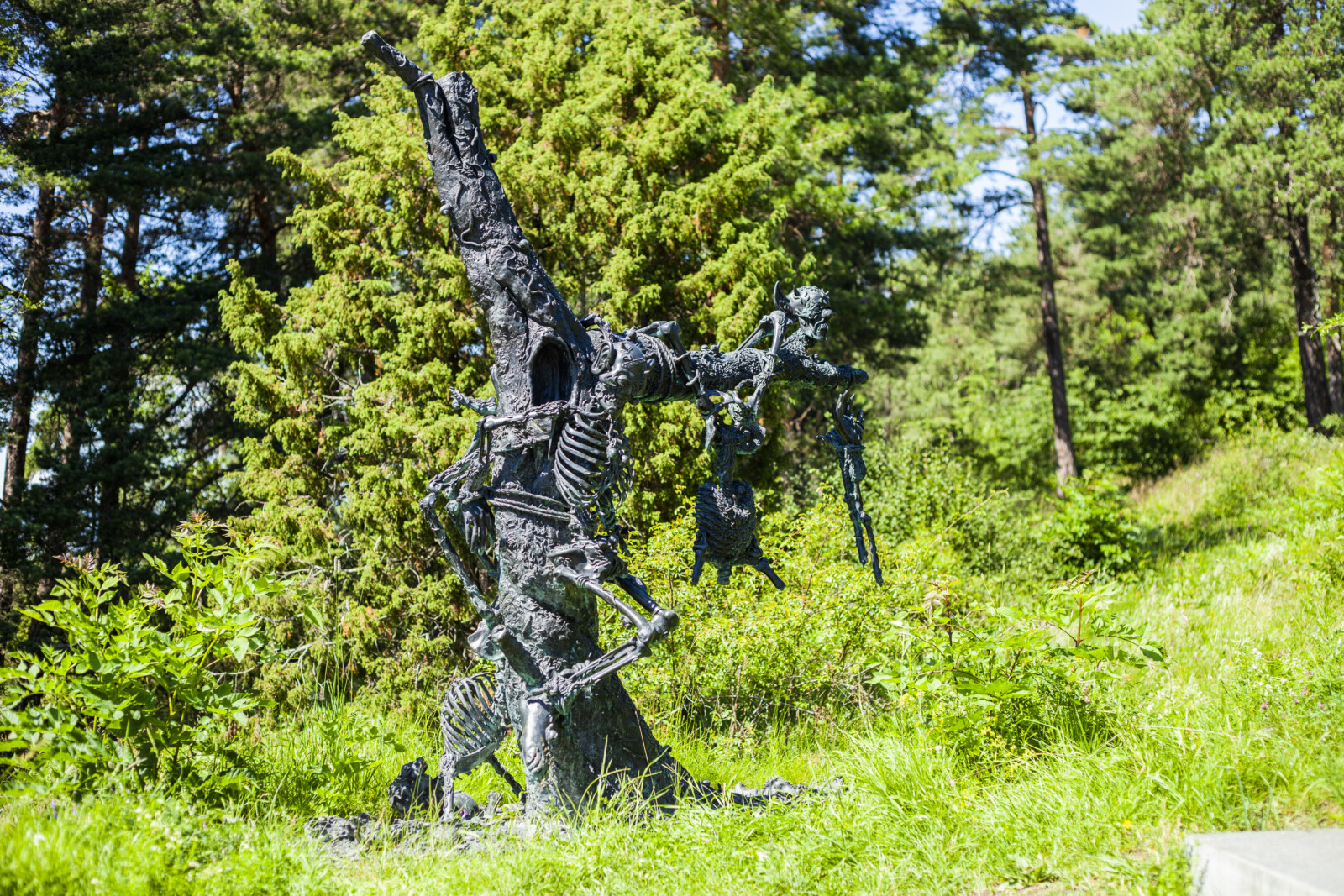
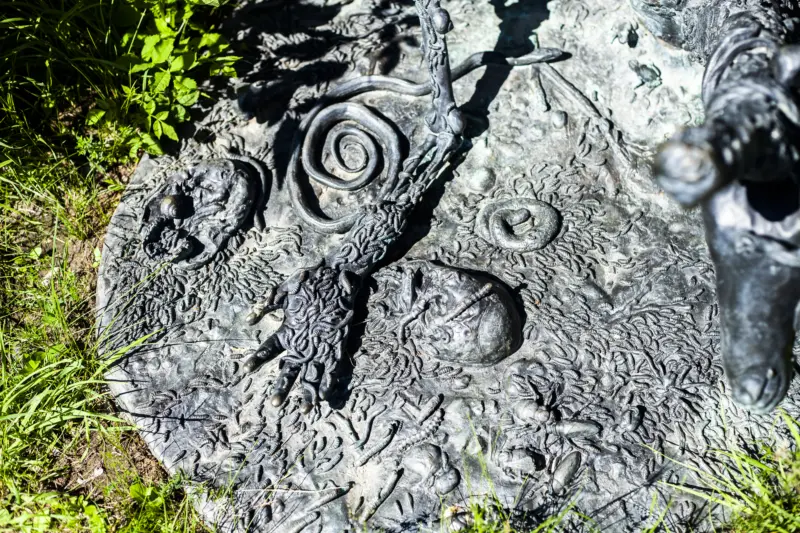
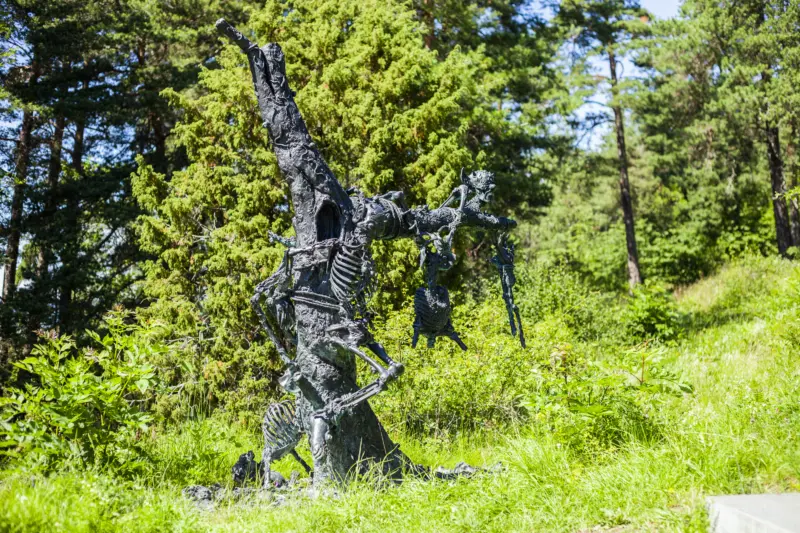
Sturm und Drang depicts a dead tree covered in worms, bugs and beetles, and worm-eaten, rotten human skeletons and body parts. The work is a direct reference to Fransisco de Goya’s work An heroic Feat! With dead men! from his series of etchings titled Desastres de la Guerra (Disasters of War, 1819-1820). This series was a strong critique of Napoleon’s aggressive war against Goya’s native Spain. Sturm und Drang show us a kind of imagery we’re already used to, through social media and news outputs, and aims to raise critical questions on how we relate to war images and whether we really take them in. Are we so fascinated by the absurd that it becomes pure entertainment?
The title Sturm und Drang is also the name of a German, romantic literary movement, active from 1770 to 1785. It was a counterforce to the Enlightenment, emphasising emotion and passion over rationality. With the author Johann W. Goethe as a leading figure, the movement wanted to shock and provoke extreme reactions and feelings. The term Sturm und Drang can also allude to a form of aggressive warfare, where the strategy is to storm the enemy.
In an early work called Disasters of War (1993), the Chapman brothers made eighty-three torture scenes using miniature plastic models, inspired by the same series of etchings by Goya. Hell (2000) is another well-known work, where they took sixty thousand toy soldiers, dressed them in Nazi uniforms, and let them suffer the holocaust they once perpetrated. The Chapman brothers are attempting to see if it is still possible to bring out an empathic reaction in the viewer by reconstructing Goya’s work with what looks like cheap plastic toys. Perhaps we are to be remined of a latent psychological darkness in each of us.
Sturm und Drang is more than just a depiction of death and decay caused by the atrocities of war. It also incorporates humorous elements such as clown noses, devil horns, and massive ears. They look like props from a horror film, toys or Halloween decorations. The artists used plastic toys and masks bought from toy shops, arranging them to recreate Goya’s motif, before casting the sculpture in bronze. The result is so exaggeratedly horrible and morbid that it becomes comic and absurd. The work comments on the contemporary treatment of death, war and torture, and the extent to which these have become entertainment. We experience atrocities daily, in the news and on social media, each one of us relating closely or distantly to the imagery we are confronted with.

Guided tours
Experience Sturm und Drang and many of the other artworks in the collection with our art mediators. We offer guided tours for private groups all year around.