
Christian Ringnes
Christian Ringnes (b.1954) holds a degree in Business Administration from HEC Lausanne and an MBA from Harvard Business School. He has had a long professional career as a consultant, investor, CEO, and board member in numerous companies. From 1984 to 2024, he served as CEO of Eiendomsspar AS, and since 2024 he has served as Executive Chairman of the Board.
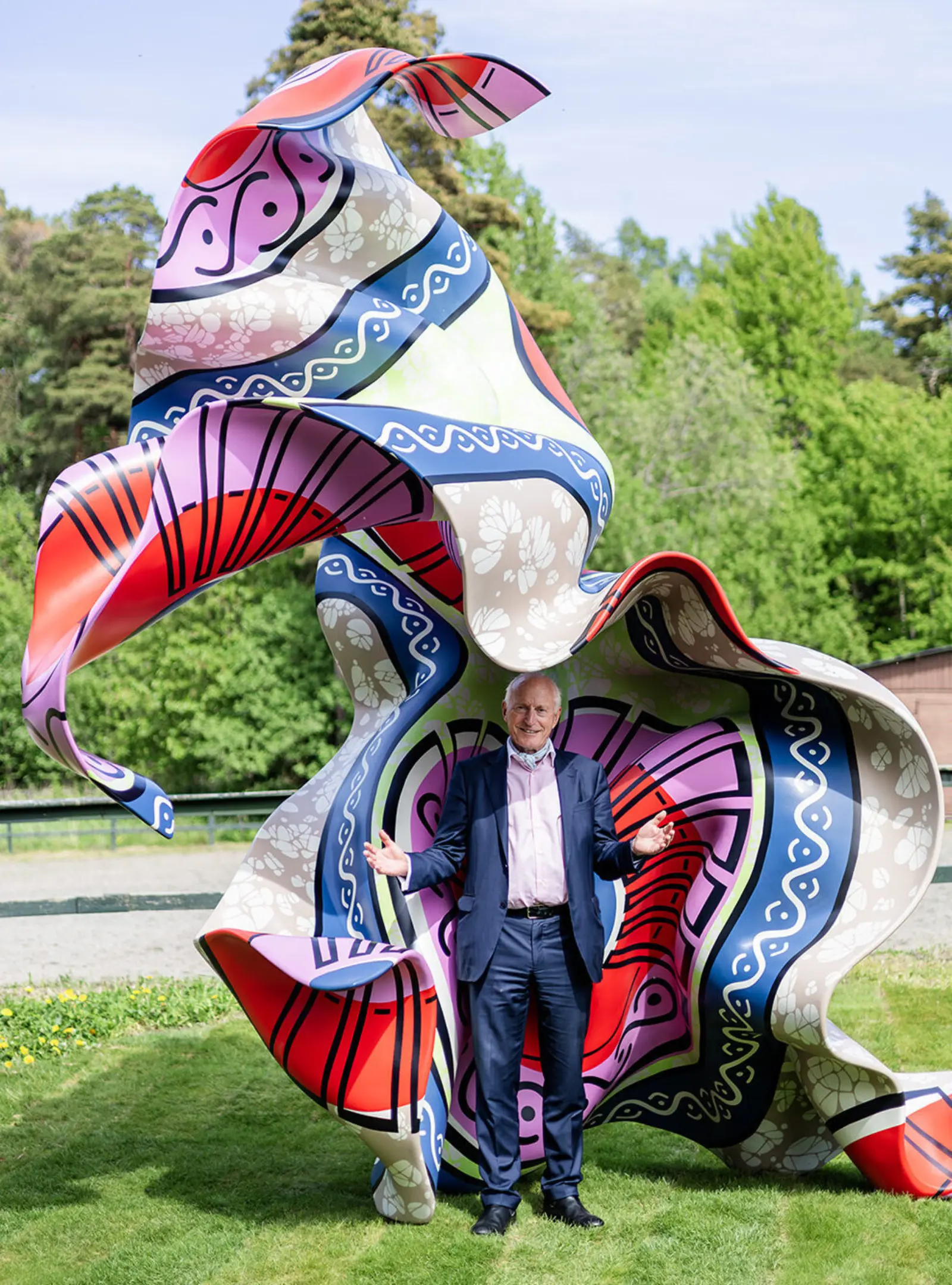
His great-grandfather, Ellef Ringnes, was one of two brothers who founded Ringnes Bryggeri in 1877. Ringnes founded C. Ludens Ringnes foundation in 2005, and is the primus motor behind Ekebergparken.
Several other works of art in public spaces across Oslo have been installed thanks to Eiendomsspar and Ringnes, including Påfuglfontenen (1989) near Nationaltheatret, Christian IVs hanske (1997) at Christiania Torv, Tigeren (2000), Fredsstjernen (2000), On The Go, Holmenkollhoppet (2026), as well as Fearless Girl (2017) by Kristen Visbal, which in 2022 was relocated to Drammensveien, near the Iranian Embassy.
He also owns the world’s largest collection of miniature bottles, displayed at The Mini Bottle Gallery in Oslo.
Seven quick questions with Christian Ringnes
Tell us about your interest in art – where does it come from?
When you get a new home, you naturally want some art on the walls. At first, reproductions and prints, and later, as your finances improve, original artworks. A fairly typical journey into art collecting — also for me. And as your collection grows, you become increasingly interested and fascinated.
Are there any particular periods or styles that interest you?
I grew up with National Romanticism and have a preference for figurative art, often with a twist that adds an extra dimension.
When did you start collecting?
My first artwork was a painting of a female skier in the Norwegian landscape by Nils Hansteen. A small painting with fantastic light, which I bought at the age of 30.
What criteria do you follow when collecting?
My own personal taste and preferences. It may not be art-historically precise, but it ensures that I truly enjoy what I buy. I have, however, learned that it is usually wise to see an artwork two or three times before purchasing it — otherwise, you may end up with a piece that lacks lasting impact.
What motivates you to share your art collection with the public?
Shared joy is double joy! It is also about giving something back to a society that has treated me well. For example, I also financed a small sculpture park at Harvard Business School, which deserves thanks for helping shape my career.
How did the idea of a sculpture park come about, and why Ekeberg?
After creating the Mini Bottle Museum in an entire building in central Oslo, I felt it would be meaningful to create something that, in addition to delighting myself, would have a broader appeal to others. If it were to become something lasting and valuable, I believed it needed to be rooted in outstanding art. Since I myself am rather devoid of artistic talent, my role had to be to stage and present what others had created.
During a sailing trip in Italy, after visiting the Boboli Gardens in Florence, I became convinced that a sculpture park was my dream project. I spent nearly ten years thinking about where and how to realize it, until Eiendomsspar AS purchased Ekebergrestauranten in 2003. The surrounding park area was worn down and felt unsafe. Gradually, the idea emerged to restore the area to the public park it had been in the early 1900s, combined with the installation of significant sculptures. And that is what happened, after nearly another decade of project development.
How has public-private cooperation shaped the Ekebergparken project?
Oslo Kommune owns the 255-acre site that is now Ekebergparken, and without cooperation with the municipality as landowner and regulatory authority, I would not have been able to realize my vision. On the other hand, the municipality did not have the available funds to restore the public park and acquire sculptures, so a significant mutual dependency emerged in order to make the project happen. During the opening celebration, the governing mayor jokingly said that Ekebergparken was an example of the perfect public-private partnership: the public sector decides — and the private sector pays!
Published 29 May 2026
The Art Committee
The committee evaluates and selects which works are to be incorporated into the collection, and where they are given their permanent place in Ekebergparken.