
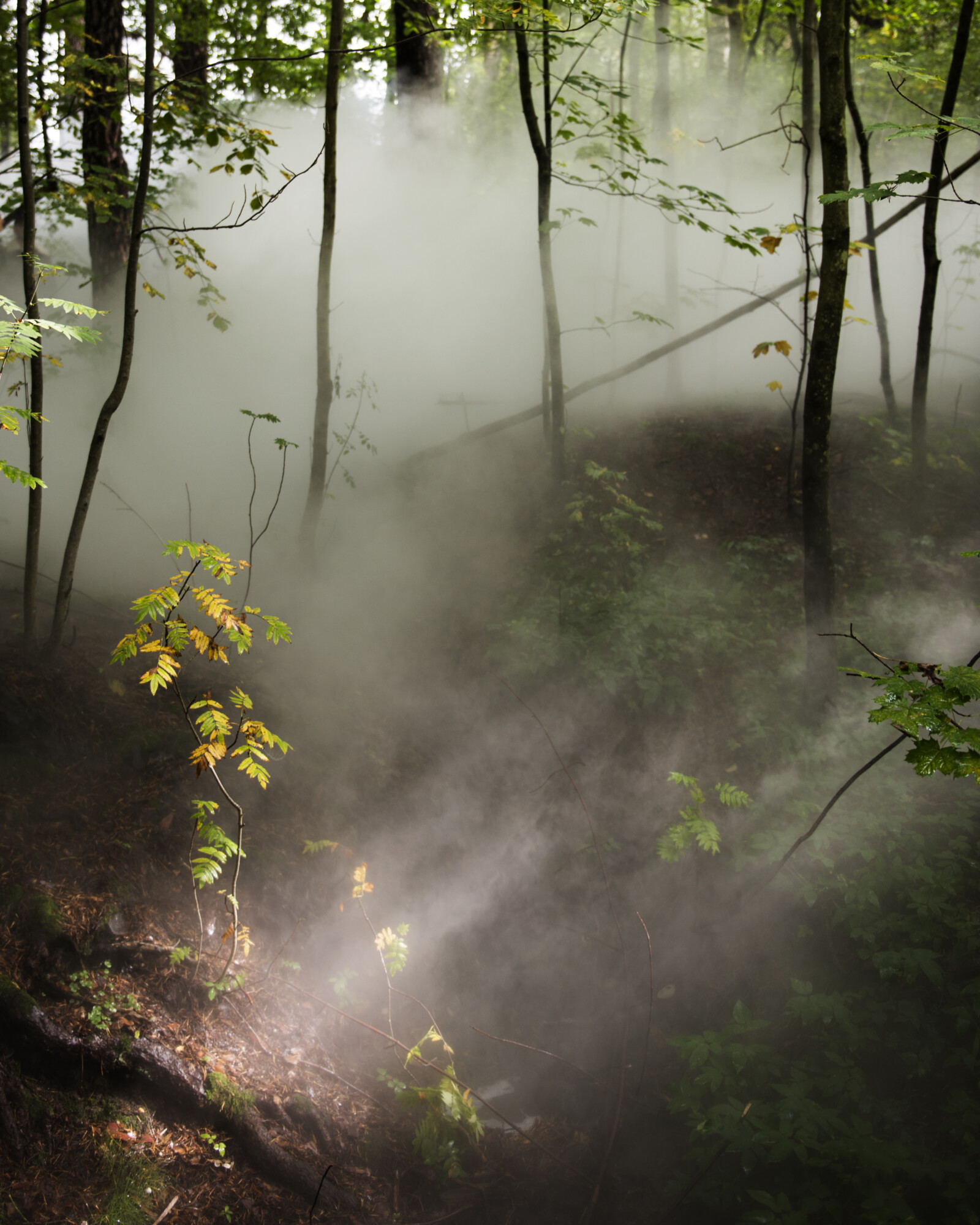
Pathfinder #18700 Oslo
- Date 2018
- Unveiled 2018
- Material Artificial fog made of water
- Available Between ca. mid April to mid October every year
- Time week days 12:30, 14:30 and 17:00
- Time Weekend 12:30, 13:30, 14:30, 17:00 and 19:00
- Duration 10 min
- Dimensions Variable
© Fujiko Nakaya / BONO. Photo: © Ivar Kvaal
«I want to provide a situation that people can physically relate to nature. For me, nature is not an object of beauty, but the beauty is in the relationship a person develop with nature.»
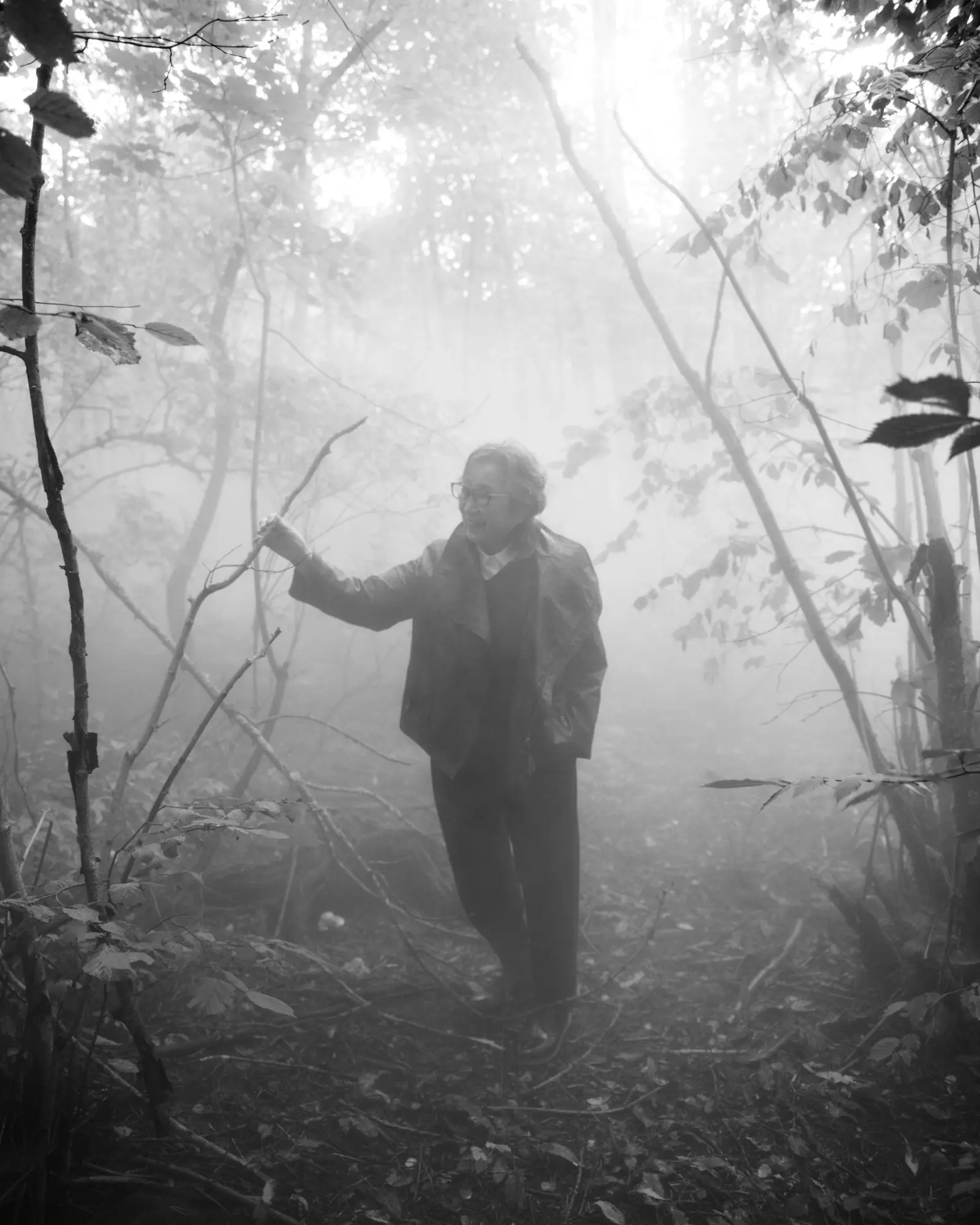
Fujiko Nakaya
(b. Sapporo, Japan, 1933)
Fujiko Nakaya started her career as a painter. She studied in Paris and Madrid, and in the end graduated from Northwestern University in Evanston, Illinois. Gradually, she became more interested in incorporating the audience in her artwork and left two-dimensional art behind. Oil painting became too restrictive and static for her, and she began exploring video art, performance, and natural phenomena such as fog. A decisive factor in her artistic career, was becoming a member of the groundbreaking organisation Experiments in Art and Technology (E.A.T), organised by the American artist Robert Rauschenberg and the Swedish-Norwegian artist Billy Klüver. They worked together in a multidisciplinary fashion through science, technology, and art to explore new materials and techniques. In 1969 she was part of E.A.T’s design team for the Pepsi Pavilion at Expo Osaka, creating an artificial fog using water and air that engulfed the whole pavilion. Artificial fog on this scale had never been made before. Since then, Nakaya has installed over fifty fog sculptures around the world; in fields and woods, at public places, outside countless art institutions, and even in a children’s playground.
Time slots
Monday - Friday:
12:30 14:30 17:00
Saturday - Sunday:
12:30 13:30 14:30 17:00 19:00
Available: From ca. April to October.
Duration: 10 minutes
Fujiko Nakaya has worked with fog and cloud sculptures at major museums and art events around the world, from the 1970 Osaka World Exhibition Expo’70, to the Guggenheim Museum in Bilbao and in 2017 at Tate Modern in London, Centre Pompidou in Paris and ARoS in Aarhus in Denmark. The title Pathfinder (# 18700 Oslo – Blindern) indicates the international code of the nearest weather station. The fog reacts to the weather conditions and cannot be controlled or formed.
In September 2017, Nakaya made a site-specific fog sculpture for the building, still under construction at the time, that would house the new National Museum, on invitation from amongst others Oslo Kunstforening, Dansens hus, and the Ultima Festival. The Ekeberg Sculpture Park was contacted the same year regarding the possibility of setting up a temporary fog sculpture, and Pathfinder was shown for the first time in the park in September 2017. It was soon decided that the sculpture would become a permanent installation.
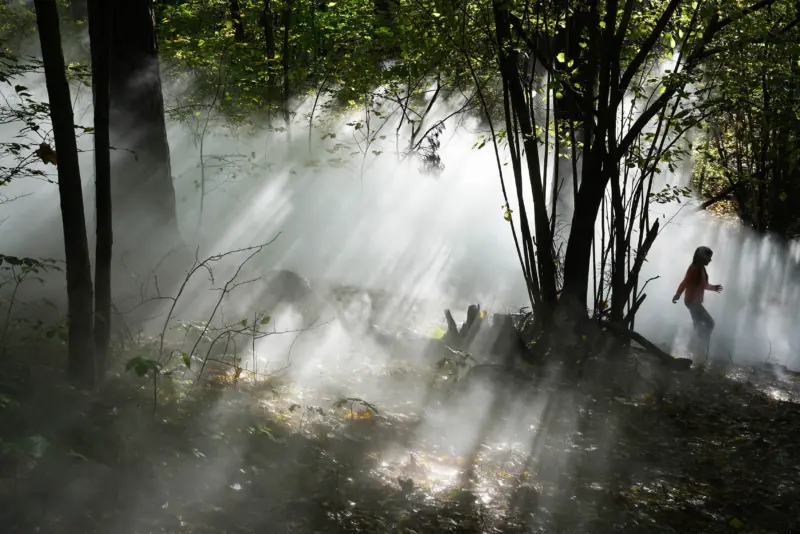
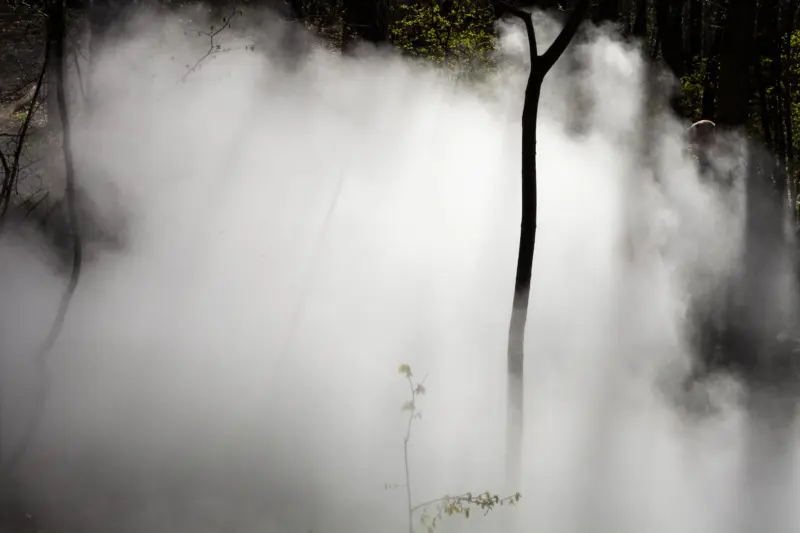
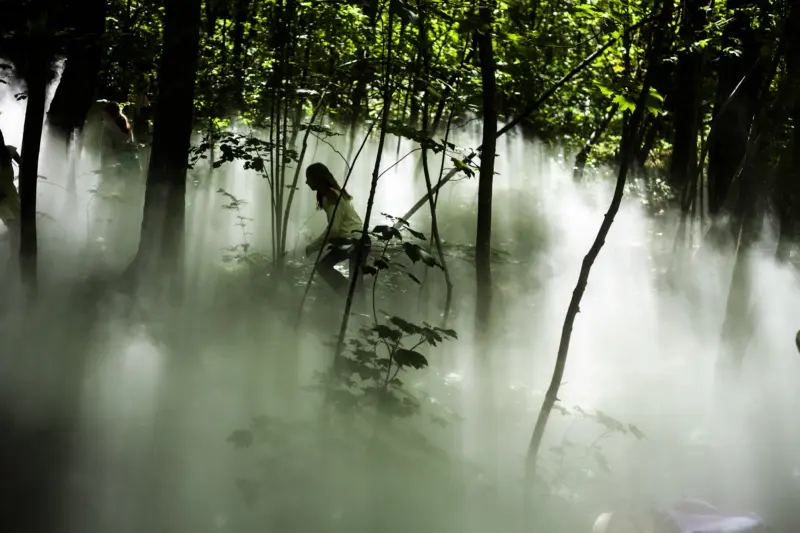
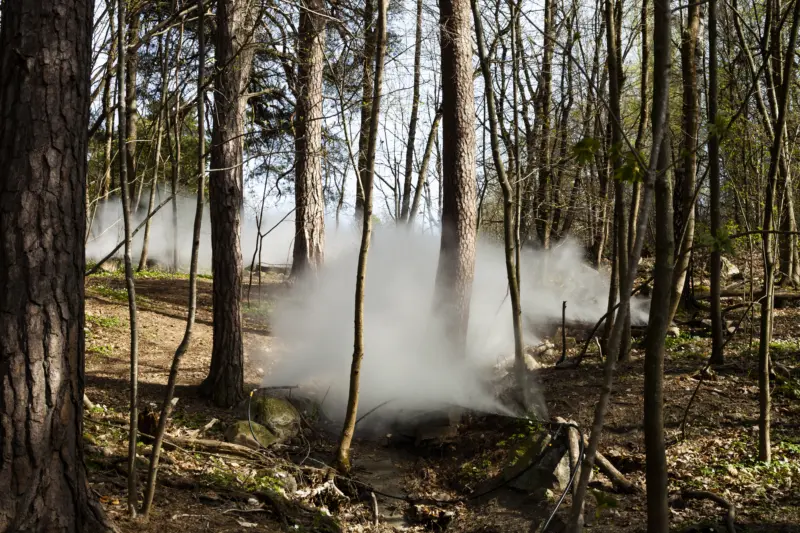
The sculpture is everchanging. At times the fog becomes so thick that it swallows up anyone who ventures into it, leaving microscopic water droplets on clothes, leaves and skin. The viewer becomes a physical part of the artwork. You are inside the material, you can feel it on your body, and you experience it both visually and physically. There is a cyclical movement in the work. The fog goes on and off with short intervals, preserving the surrounding environment, while also producing an aesthetic experience of the surroundings that disappear only to be rediscovered, as the fog spreads and gradually disperses again. For Nakaya, this is a representation of the natural cycle of appearing, disappearing and reappearing. The atmospheric conditions that normally are invisible to the naked eye, become visible in the fog that billows through the woods. It is the wind itself, as Nakaya often points out, that is the chisel that shapes the sculpture.
It isn’t the fog as a material that is important to Nakaya, but rather the fog as a medium that gives us access to what nature can provide. The fog sculptures do not recreate nature; they enter in a dialogue with it. Nakaya’s interest in natural cycles and nature’s mechanisms stems from her father, Ukichiro Nakaya (1900–1962). Ukichiro was a famous Japanese physicist, researching the fields of glaciology, electrostatic emissions and snow crystals. He is known for being the first person to make artificial snowflakes.
Nakaya’s fog sculptures break with the traditional understanding we have of the medium of sculpture and are an exciting synthesis of art and technology. The fog is artificial in the sense that it is generated by technology, but natural in terms of the material, which consists simply of water droplets. Nakaya has a long-standing and continued collaboration with the physicist Tom Mee. He is known as “the fog spinner” and is the man behind the patented fog technology. Water is pumped at high pressure through microscopic apertures installed in needle valves. The valves divide the water jets into drops so small they remain hanging in the atmosphere.
Guided tours
Experience Pathfinder and many of the other artworks in the collection with our art mediators. We offer guided tours for private groups all year round.