
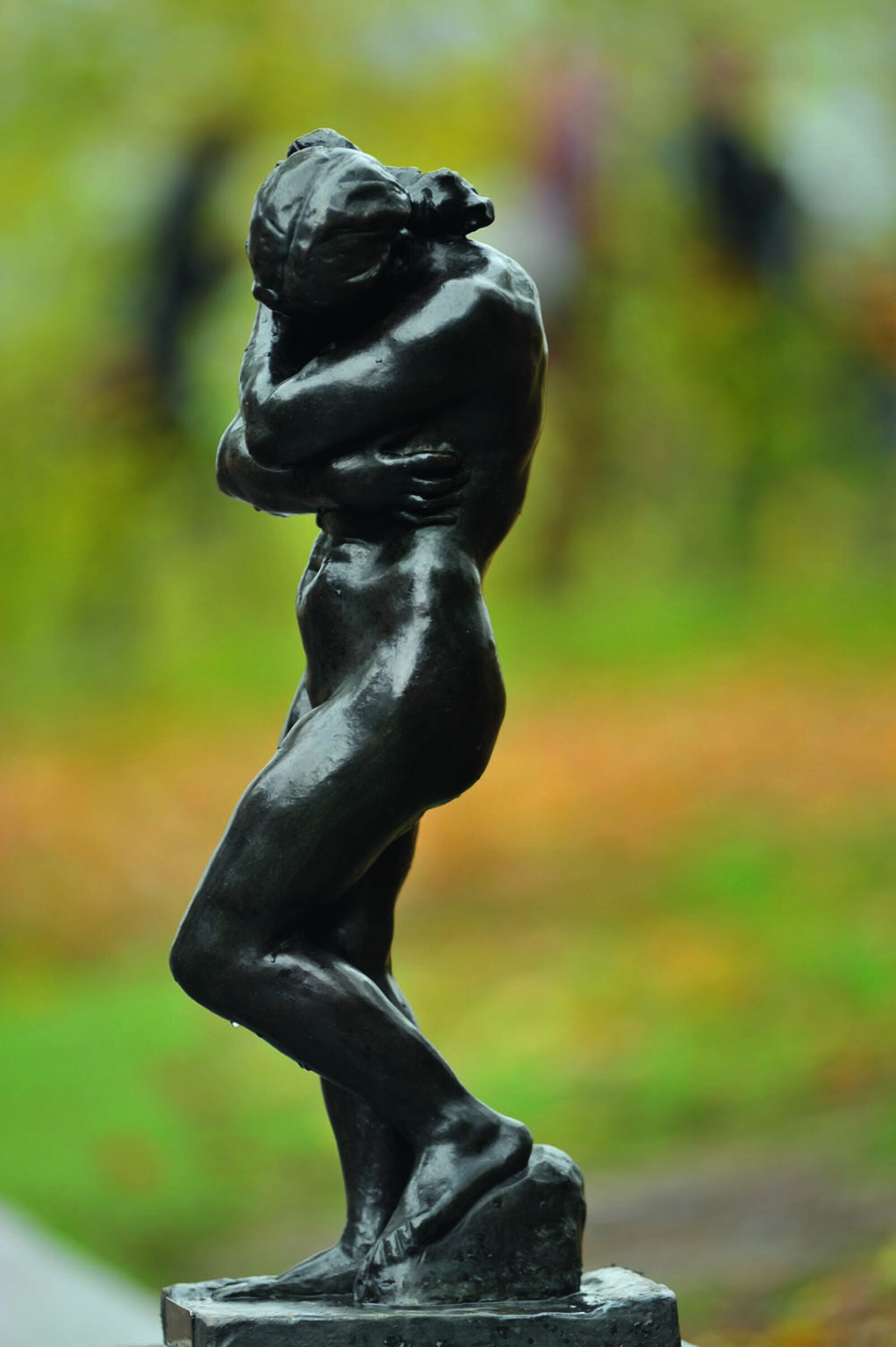
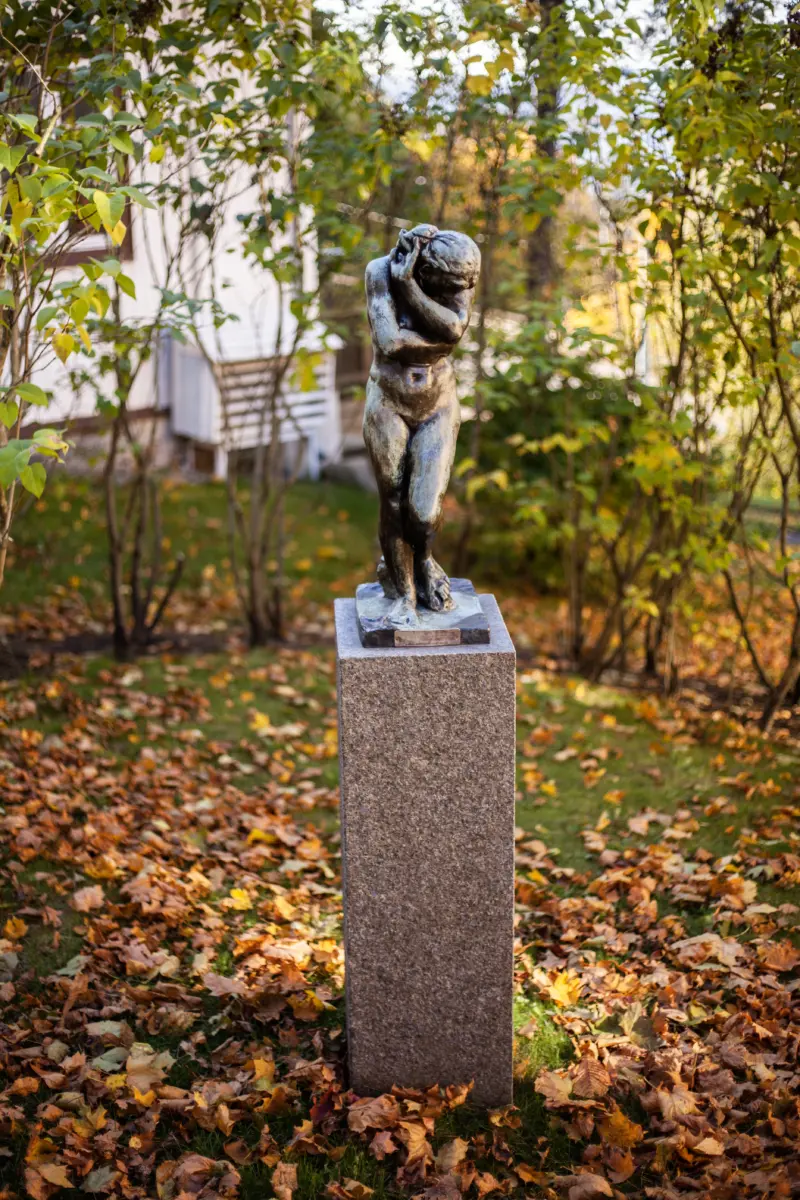
Ève
- Date 1881
- Unveiled 2013
- Material Bronze
- Dimensions 84 cm
Photo: © Knut Bry
«Nothing immoral can ever exist in art. Art is always hallowed.»

Auguste Rodin
(b. Paris, France, 1840-1917)
Auguste Rodin is one of the world’s most famous sculptors in the figurative and realistic style. In his work, one can clearly see the influence of the Greco-Roman antiquity. But also, other movements, such as the neo-Gothic. It became clear to Rodin early on that he wanted to become an artist, but the path was long and difficult. In the 1880s, however, success was a fact, and by the turn of the century he was internationally recognised as an artist. The fact that he left traces of the modelling process, even in the finished works, was groundbreaking for his time.
Éve depicts the Bible's first woman just after the fall from grace. The age of innocence is past, and she bows her head as she tries to conceal her nakedness.
Éve originated as a part of The Gates of Hell, a work in the shape of a portal to a French museum of decorative arts that was planned, but never actually built. Rodin placed Adam and Eve on opposite sides of the entrance. This is just one of several figures from the portal that has been singled out for use as individual artworks. The other Rodin sculpture in the park, Cariatide tombée à l’urne, is derived from the portal as well, as is the world famous The Thinker.
In 1881, Rodin was commissioned by the French Ministry of Culture to make two monumental sculptures of Adam and Eve. Rodin wanted to place them on either side of his composition The Gates of Hell, inspired by Dante’s Divine Comedy, which depicts human suffering in hell, purgatory, as well as paradise. Adam and Eve were meant to stand as eternal witnesses to the consequences of their sins—physical death and damnation of souls. The work on The Gates of Hell was originally supposed to take five years, but it became a kind of obsession for Rodin – his main work, and continued for 37 years, until his death in 1917. During Rodin’s lifetime, the work existed only in plaster form in his studio in Meudon, on the outskirts of Paris. Jules Mastbaum, founder of The Rodin Museum in Philadelphia, had The Gates of Hell cast in bronze in 1925 – in an edition of two, one for Philadelphia and one for the Musée Rodin in Paris.
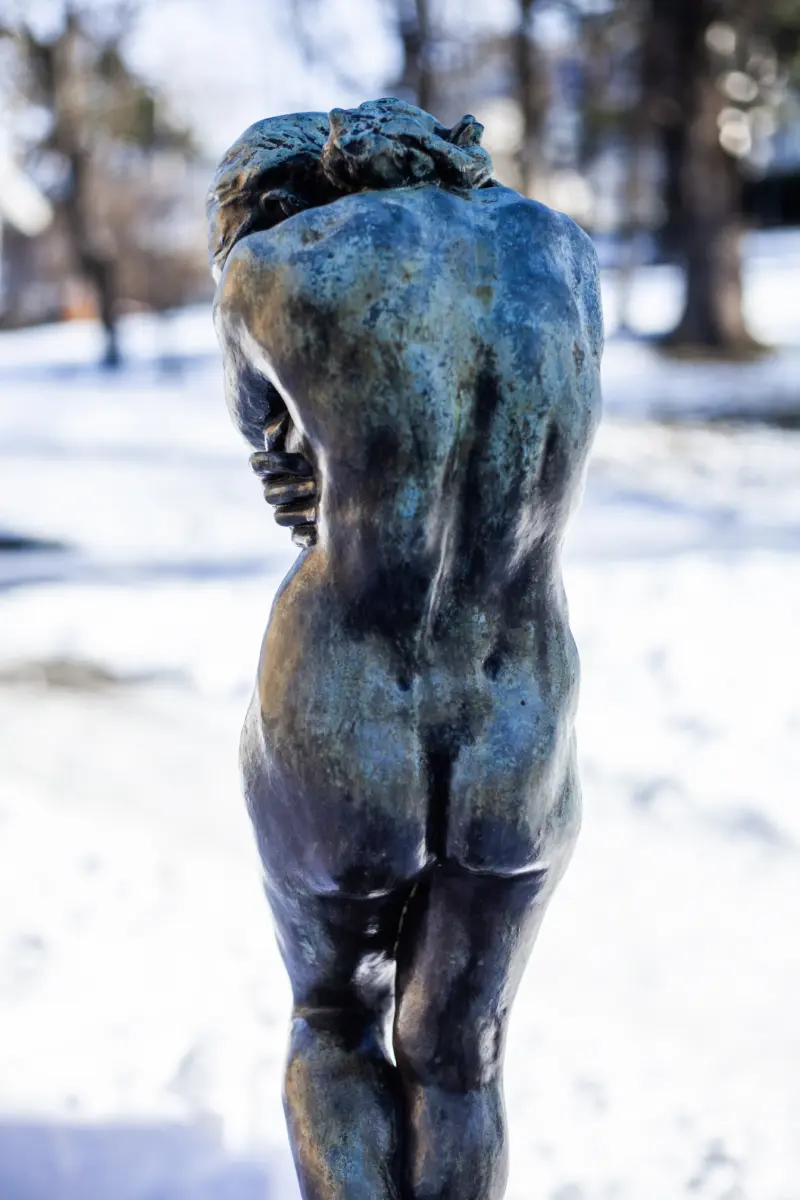
Ève is one of several smaller casts and functions as an independent piece. Eve’s body becomes a physical manifestation of remorse: the body is twisted in pain, and her face is caught in eternal torment. You can see how the stomach muscles tense up as she turns away, how the hips move to the side and her back hunches over. She shields her face as though she is surrounded by fire.
Rodin is said to have been overjoyed when he found out that his model for Ève was pregnant, because he felt it made her movements even more expressive. But posing soon became too strenuous for the model and she stopped coming to the studio. Work on Ève came to a halt and the areas around the stomach and the head remained less detailed and unfinished. Ève was modelled in 1881, but not cast in bronze until 1925, after Rodin’s death. This was also the case for The Gates of Hell, which he worked on for over thirty-seven years; it only existed as a plaster model in his studio during his lifetime. Today, a version of this and another version of Ève, as well as Adam, can be found at the Rodin Museum in Philadelphia. Rodin changed his mind regarding the placement of the figures at the gate, in part because they ended up being different sizes. Adam was overdimensioned, while the versions of Ève were life-size or smaller.
Rodin got his inspiration for Ève and her counterpart, Adam, from Michelangelo, whose works he studied at the Louvre in Paris as a young man. Ève’s posture has been taken straight from The Fall from Grace and Adam’s posture is from The Creation of Adam in the Sistine Chapel (1508–12).The original placement could have been inspired by Michelangelo’s marble sculptures, The Dying Slave (1513– 1516) and The Rebellious Slave (1513), found today on either side of La Porta Stanga in the Louvre.
Guided tours
Experience Ève and many of the other artworks in the collection with our art mediators. We offer guided tours for private groups all year round.