
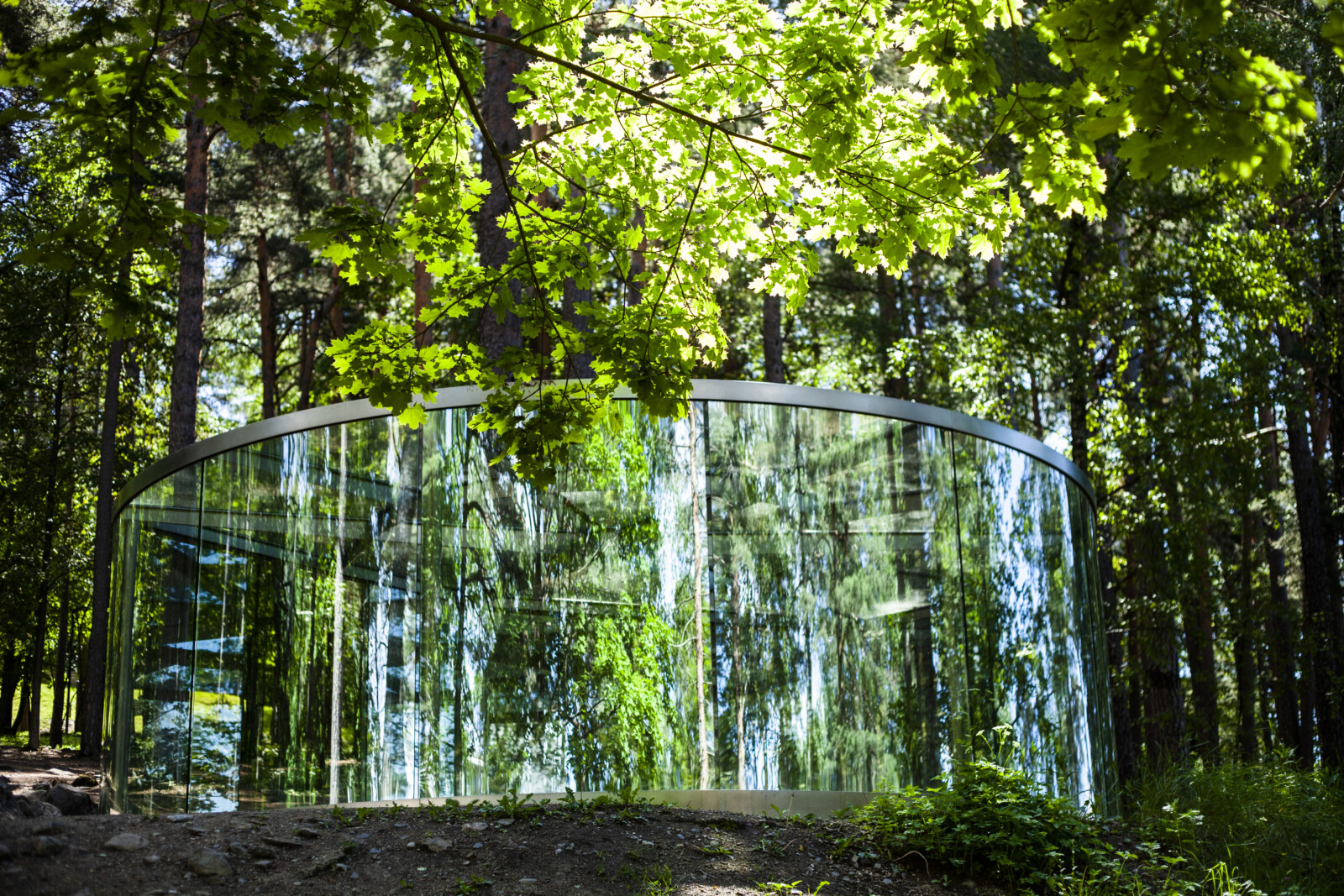
Ekeberg Pavilion
- Date 2013
- Unveiled 2013
- Material Glas, stone, steel
- Details Site Spesific
- Dimensions 260 x 55 x 715 cm
© Dan Graham / BONO. Photo: © Kristina A. Kvåle / Ekebergparken
«All artists are alike. They dream of doing something that's more social, more collaborative, more real than art.»
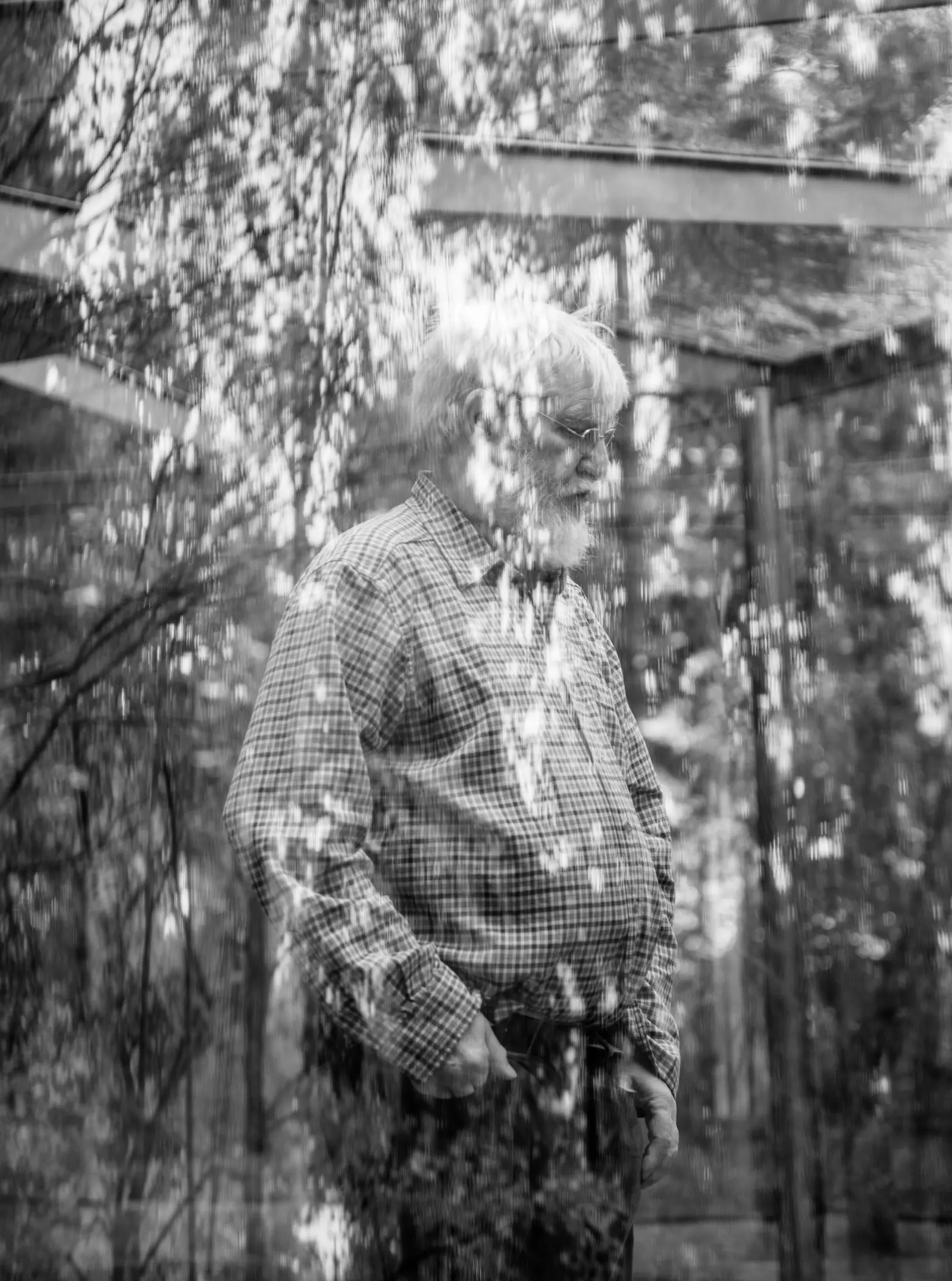
Dan Graham
(b. Urbana, United States, 1942-2022)
Dan Graham started out as a gallerist and critic. He was self-taught, with no further education beyond high school. In his early 20s, he co-established John Daniels Gallery in New York, where many artists oriented towards minimalism would show their work, often early on in their carreers; Sol Lewitt being one example. Graham’s first solo exhibition as an artist was at John Daniels in 1969. With his site specific and conceptual art, Graham became a prominent figure on the avant-garde art scene in New York in the 1970s, alongside Robert Smithson (1938–1973), known for his land art, and Gordon Matta-Clark (1943–1978), whose practice was more politically engaged and directed toward architectonic art projects. Graham’s artistic expression was diverse and interdisciplinary. It included photography, performance, video installation, architectural models and the installations which have made him world famous - the glass pavilions. While his approach to art was intellectual and attested to abstraction and minimalism, he never lost sight of the human condition and cultural progress. His works always relate to the public; they confront the spectators and to make them envision themselves as part of the work itself. His glass pavilions dissolve the boundaries between art, surroundings and onlooker. Dan Graham participated in Skulpturstopp and Artscape Nordland with glass pavilions at Lemonsjøen in Vågå and in Lyngvær, Vågan, inaugurated in 1996. Among larger displays of his work, Public/Private (1994) at the Moore College of Art and Design in Philadelphia must be mentioned. A large retrospective was held in 2001, at Musee d’Art Moderne de la Ville in Paris, Kroller-Müller Museum, in Otterlo, The Netherlands, and Kiasma Museum in Helsinki. 2009 was marked with major retrospectives at the Museum of Contemporary Art, Los Angeles; Whitney Museum of American Art, New York; and the Walker Art Center, Minneapolis. Graham also exhibited at the Venice Biennale in 1976, 2003, 2004 and 2005, at Documenta V, VI, VII, IX and X (1972, 1977, 1982, 1992 and 1997), and at Skulptur Projekte Münster 1987 and 1997.
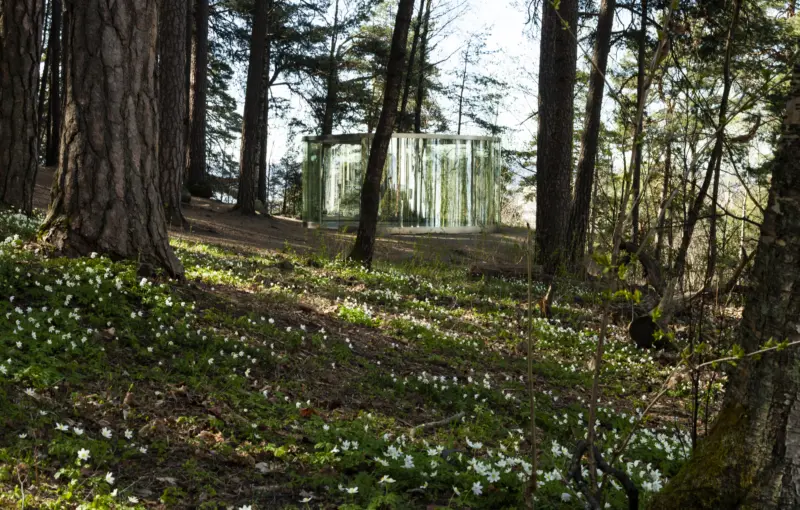
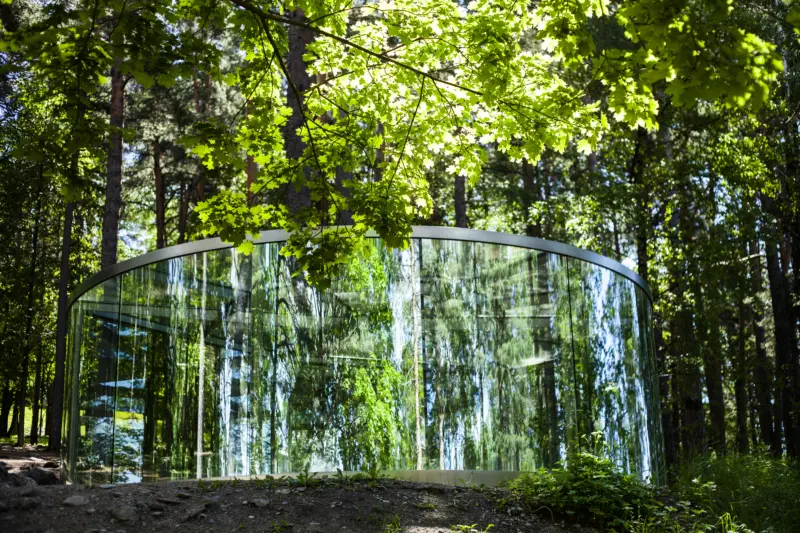
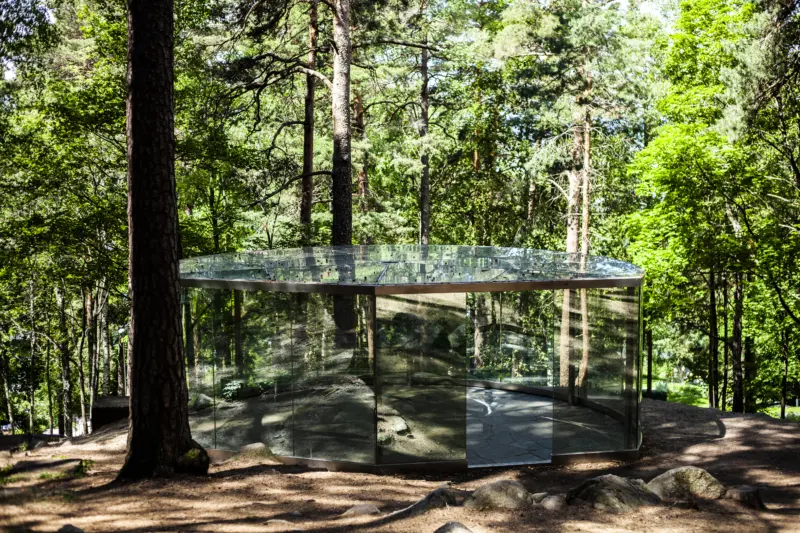
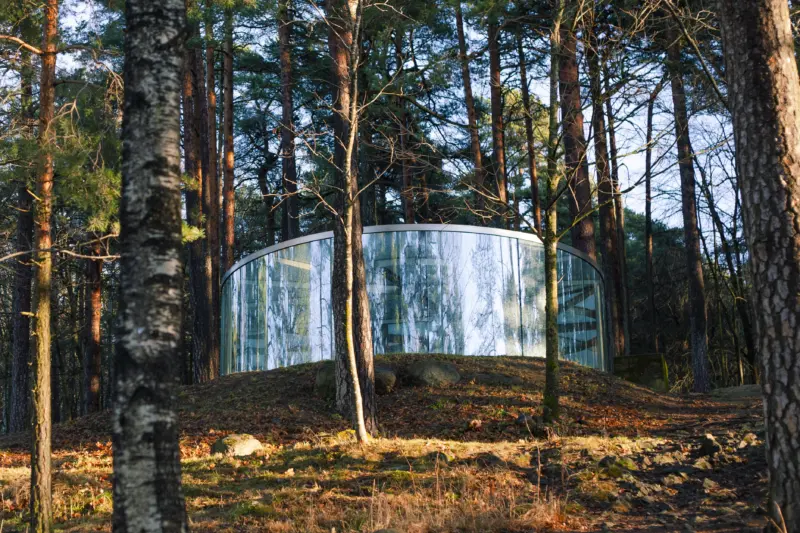
In Ekeberg Pavilion Graham invites the audience into an artwork that is equal parts an architectural space and an event. The work was commissioned especially for the spot where it has been erected, and stands on the foundation of the music pavilion that was in active use in the years following the turn of the century, when the park was teeming with life. This site-specific approach lets the artist explore the way the surroundings influence the work itself – and how the artwork can activate the site’s history.
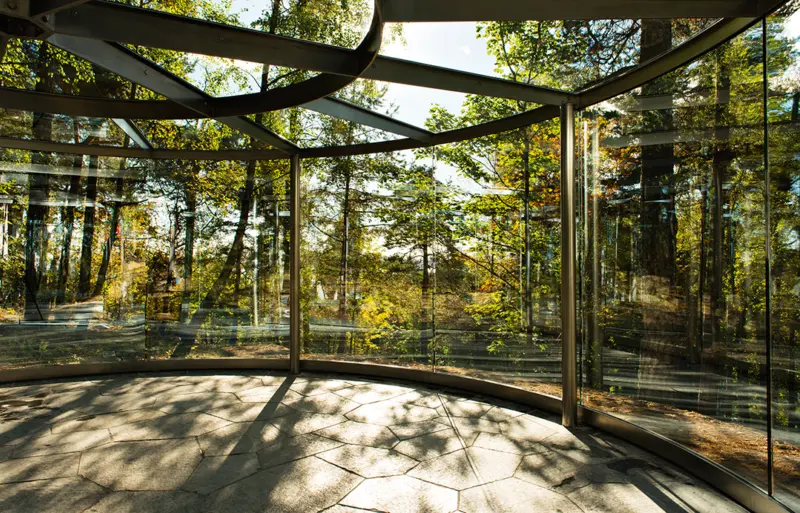
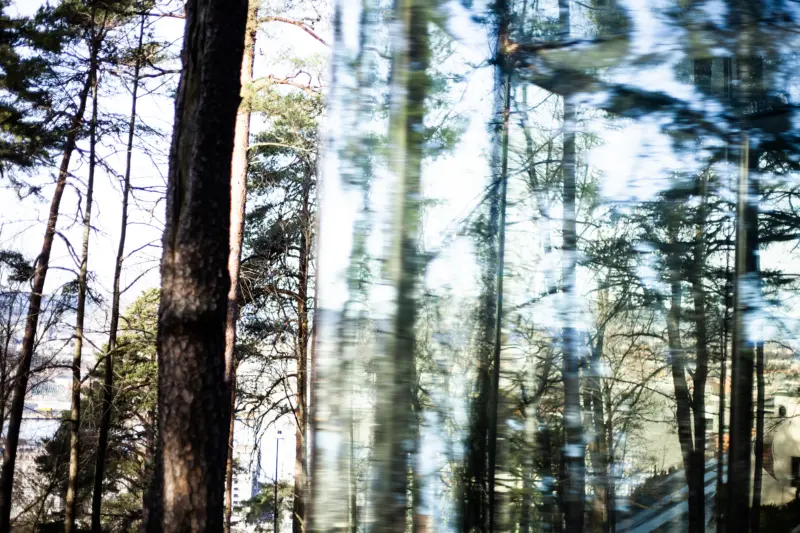
Graham started making glass pavilions towards the end of the 1970s, placed in public spaces and natural landscapes around the world. By being both reflective and transparent, depending on the light conditions, the glass pavilions dissolve the physical and visual barriers between artwork, viewer and surroundings. This relationship between the viewer, artwork, architecture and surroundings is central to Graham’s work. The viewer sees themselves reflected in the artwork and becomes an integral part of it. Graham was preoccupied with the role of the viewer and explored ways in which his artwork did not fully come to their own until activated by the audience. The glass pavilions vary in size but have obvious common features. They are made in simple architectonic forms, often with curved glass and two-way mirror modules installed using steel frames.
During the autumn of 2010, in connection with the establishment of the park, the art committee appointed by the municipality and the C. Ludens Ringnes Foundation approached artists who were known for working with site-specific art. James Turrell, Marina Abramović, Tony Oursler, Jenny Holzer and Dan Graham were invited to come to Oslo to explore the park and to make proposals inspired by the cultural history of the area. Dan Graham found a connection to his glass pavilions in the remnants of a music pavilion from the 19th century.
Learn more about the music pavilion from the 19th century
Guided tours
Experience Ekeberg Pavilion and the other artworks in the collection with our art mediators. We offer guided tours for private groups all year round.