
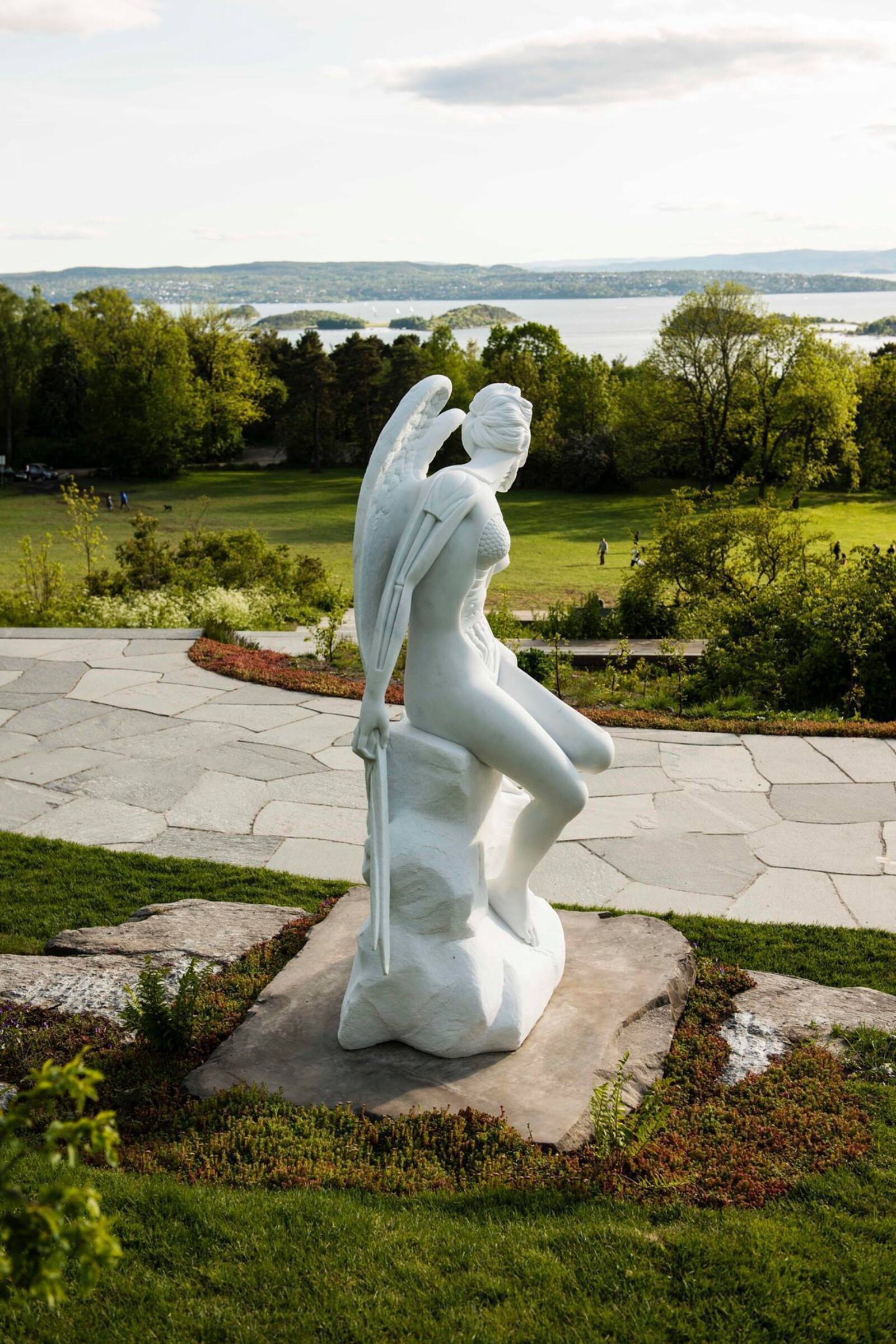
Anatomy of an Angel
- Date 2008
- Unveiled 2015
- Material Carrara marble
- Dimensions 187 x 98 x 78,5 cm
© Damien Hirst and Science Ltd. All rights reserved, DACS / BONO. Photo: © Ivar Kvaal
«I’ve always felt that the responsibility is on the viewer, not the artist. You trick the viewer into thinking that you’re telling them something, but you’re revealing something that they already have. It’s like magic.»

Damien Hirst
(b. Bristol, United Kingdom, 1965)
Damien Hirst was born in Bristol and studied Fine Arts at Goldsmiths College in London towards the end of the 1980s. He made his first spot painting in 1987, and started exploring experimental art, quickly becoming part of the avant-garde art movement known as YBA (Young British Artists). In 1993, his installation Mother and Child (Divided) (1993) was shown at the Venice Biennale, leading to his major international breakthrough. In 1995 he won the prestigious Turner Prize. Hirst is an artist who surprises, provokes, inspires and excites his audiences. His use of painting, drawing and various installations explore the relationship between art, beauty, religion, science, life and death. He is to be counted among the superstars of contemporary art. His work is included in collections world-wide, and several of his works are in the collection of the Astrup Fearnley Museum in Oslo.
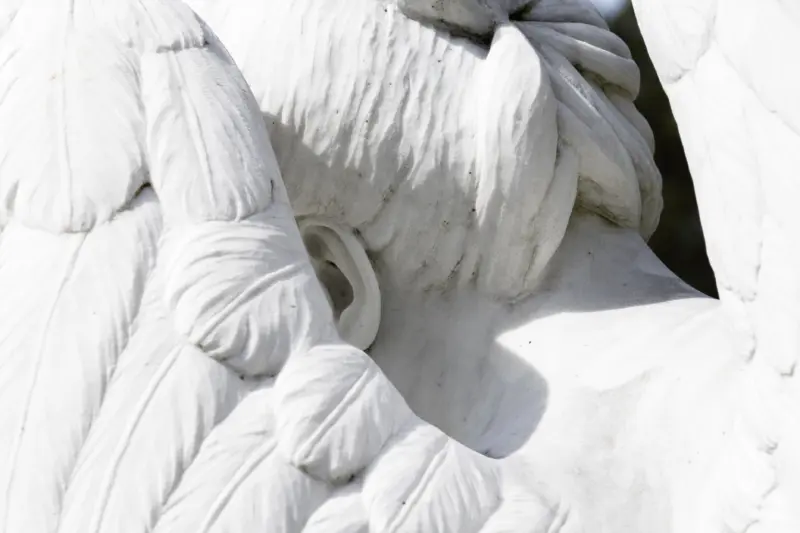
Anatomy of an Angel is hewn in Carrara marble and the artist's first sculpture in this material. Hirst has chosen to give the angel the anatomy of a normal, mortal woman. The structures beneath the skin are laid bare, as if by anatomical examination. Hirst fuses his interest in religious iconography with the notion that science itself is somehow sacred.
In his practice, Hirst draws on longstanding traditions in art, namely the memento mori and the vanitas genres – with works like For the Love of God (2007), where he covered a human skull with diamonds, and Mother and Child (Divided) (1993) and In and Out of Love (1991), where he exhibits real animals, both dead and alive. His work has been described as shocking and confrontational, directing our attention to an inescapable fact of our lives—death and our relationship to it.
Anatomy of an Angel is almost identical to L’hirondelle blessée (1920) by Alfred Boucher (1850–1934), a classic and elegant female sculpture with wings. Hirst’s angel has been enlarged, and several layers of the skin has been removed to expose the intestines, eyeball, skull, ligaments, and muscles. The sculpture is made of Carrara marble, a material favoured by Michelangelo, as it allows an extreme level of delicate detail. It builds on Hirst’s other works Hymn (1999-2005), Myth (2010) og The Virgin Mother (2005-2006), where he also exposes the body’s anatomy, showcasing the artist’s fascination with the meeting between medicine and religious iconography. During the renaissance art students used to study cadavers and artists like Da Vinci and Michelangelo produced detailed drawings exposing the body’s anatomy. In this way, art and medical science have developed hand in hand throughout time, despite the church objecting to dissection as a desecration of the human body. For Hirst, science is the new religion. Hirst’s angel is dissected and exposes an anatomy that shows her as human after all.



Guided tours
Experience Anatomy of an Angel and many of the other artworks in the collection with our art mediators. We offer guided tours for private groups all year around.